Who Is Banksy? Why the Anonymity Is the Artwork
After three decades, the most famous living artist is still unidentified. The usual question is who is under the hood. The more interesting one is what the anonymity actually does, and why revealing it would destroy something the work depends on.
Admin
Author
✨ You might also like
New York City Map Art Print Set
A matched set of two city map art prints for New York City: Empire State Building & Brooklyn Bridge. Digital download, print at home or any lab.
Bangkok Map Art Print Set
A matched set of two city map art prints for Bangkok: Wat Arun & Grand Palace. Digital download, print at home or any lab.
🎭 The Question Everyone Asks First
Banksy has been working for roughly thirty years, sells at auction for millions, has directed a film and built a hotel, and nobody has confirmed who he is.
The name that comes up most often is Robin Gunningham, a Bristol man identified by journalists and later supported by academic analysis of where the works appeared. It has never been confirmed, and Banksy has never acknowledged it.
So the honest answer to "who is Banksy" is: unconfirmed, with one persistent candidate. That is unsatisfying, and the dissatisfaction is doing more work than most people notice.
🥷 Why the Anonymity Started, and Why It Changed
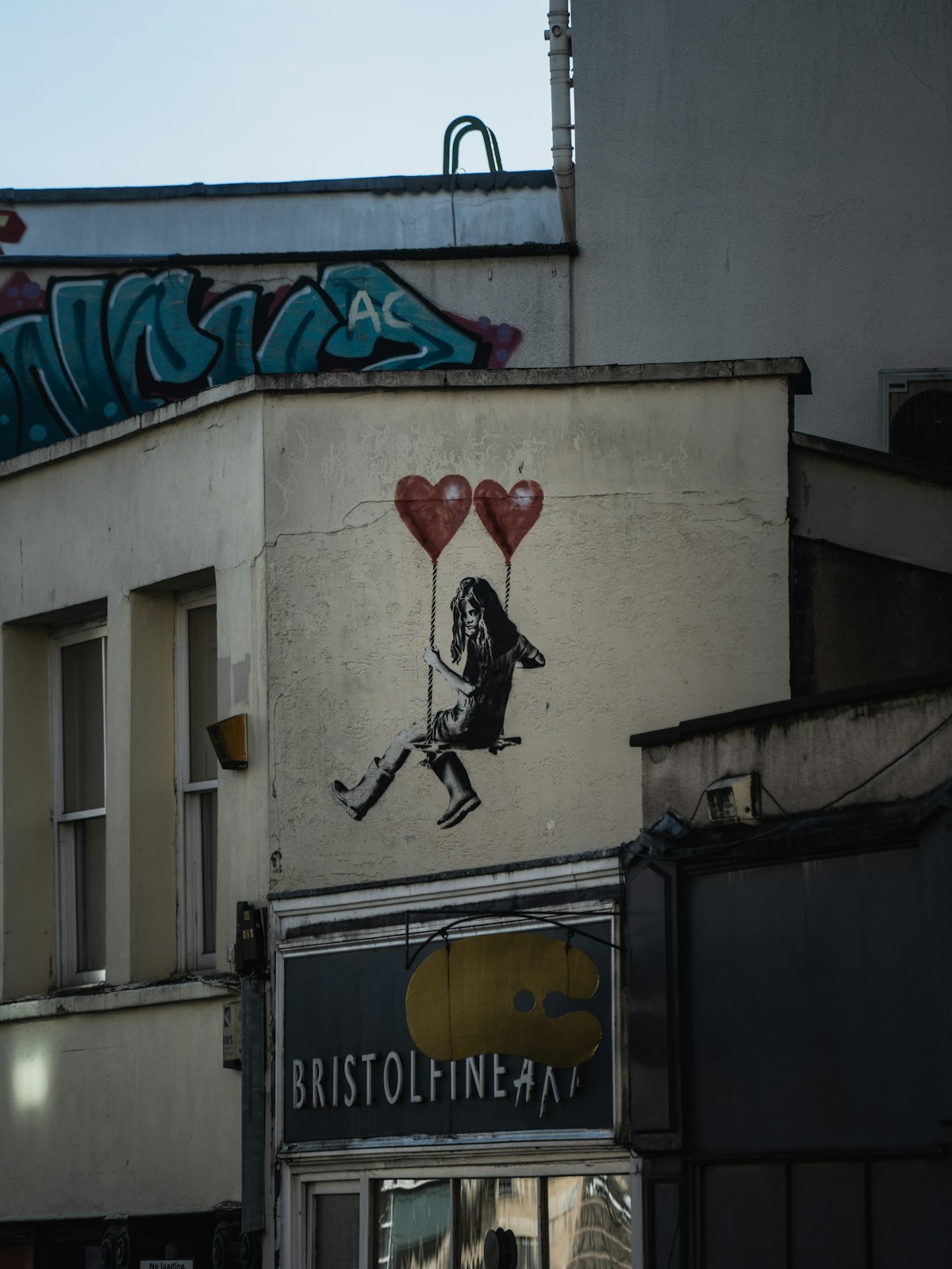
It began as practical. Graffiti is criminal damage. An identified graffiti artist is a prosecutable graffiti artist, and the early work was done fast, at night, in places where being recognised carried a real cost.
The stencil technique came from the same pressure. A stencil can be prepared in advance and applied in seconds, where a freehand piece takes hours of standing still in public. The style everyone now recognises was, at the start, a way of not getting caught.
But somewhere in the 2000s the anonymity stopped being protective and became structural. By then Banksy could have afforded lawyers, galleries and a public identity. Staying hidden was no longer necessary. It had become part of the work.
🧩 What the Anonymity Actually Does
Four things, and they are worth separating.
It removes the biography. Almost all art criticism runs on the artist's life: their background, their traumas, their intentions. Remove that and there is nothing to interpret except the piece and its location. You cannot ask what he meant. You can only look at what is on the wall.
It makes the work impossible to co-opt. An artist with a public identity can be invited, sponsored, given a retrospective, gradually absorbed into the institutions they criticise. Anonymity blocks that. There is nobody to invite.
It transfers ownership to the public. When a piece appears on a wall overnight, the neighbourhood finds it, argues about it, sometimes protects it with perspex, sometimes paints over it. That argument is part of the work, and it only happens because no author is present to settle it.
It makes the persona bigger than any person could be. This is the risky one. "Banksy" as an idea is more compelling than any individual would be. A named man in his fifties from Bristol is a person. An unidentified figure who appears on walls is a myth, and myths carry further.
💰 The Contradiction Nobody Resolves
Here is where it gets genuinely complicated, and where most coverage goes soft.
The work is anti-establishment, anti-capitalist, anti-art-market. And it sells for enormous sums. Devolved Parliament, showing the House of Commons populated by apes, went for around £9.9 million. Game Changer, painted for a hospital during the pandemic, reached about £16.8 million, with proceeds going to the NHS.
The most famous response to this was the 2018 Sotheby's auction, where Girl with Balloon began shredding itself moments after selling. A shredder had been built into the frame years earlier, waiting.
It is usually described as an attack on the art market. It is worth noticing what actually happened: the shredded piece was renamed Love is in the Bin, and when it returned to auction it sold for many times the original price. The market did not reject the gesture. It priced it.
That is not a failure of the stunt so much as a demonstration of the thing it was pointing at. A market that can absorb an artwork destroying itself can absorb anything. Whether Banksy intended that lesson or merely provided it is exactly the kind of question the anonymity makes unanswerable.
🏚️ The Works That Were Not Paintings
The pieces that hold up best are the ones that could not be hung on a wall.
Dismaland, in 2015, was a derelict seaside site in Weston-super-Mare turned into a failing theme park, staffed by deliberately miserable attendants, featuring work by dozens of other artists. It ran for a few weeks and drew enormous crowds to a town that badly needed them.
The Walled Off Hotel, opened in Bethlehem in 2017, advertised "the worst view in the world": rooms facing the separation wall. It functioned as a real hotel, a museum and a piece of argument at once.
Better Out Than In, a New York residency in 2013, put a new piece on the street every day for a month, announced only through social media. It turned a city into a treasure hunt and turned the audience into participants.
What these share is that they are not objects. They are situations, and a situation cannot be bought at auction, which may be the point.
🔍 Should the Identity Be Revealed?
Journalists have pursued this for years, and the argument for it is straightforward: a figure with this much cultural influence should be accountable, and public interest is real.
The argument against is not really about privacy. It is that revealing it would remove something the work runs on.
The moment there is a name and a face, every piece acquires a biography. The wall becomes a statement by a specific man with a specific history and specific commercial interests. That is not necessarily worse, but it is unquestionably different, and it is not recoverable. You cannot un-know it.
There is also a plainer point. Thirty years of work exists and is available to look at. The identity would add a fact and subtract an experience.
🤖 A Question This Sets Up
If a body of work can function with no known author, it raises an obvious follow-on: how much does authorship matter at all?
That question has become considerably less theoretical now that software can generate images on demand, with no author in any traditional sense. We look at that in AI art and what it means for authorship, which is the natural companion to this one.
✅ The Short Version
- Banksy's identity is unconfirmed. Robin Gunningham is the persistent candidate, never acknowledged.
- Anonymity began as protection from prosecution and became structural. The stencil style came from the same need for speed.
- It removes biography, blocks institutional co-option, hands interpretation to the public, and lets the persona outgrow any person.
- The anti-market stance and the millions coexist unresolved. The self-shredding piece resold for far more as Love is in the Bin.
- The strongest works, Dismaland, the Walled Off Hotel, the New York residency, were situations rather than objects.
🔗 Recommended Resources
Wall and Piece by BanksyAmazon
The artist's own book
Banksy: You Are an Acceptable Level of ThreatAmazon
Best photographic survey
Street art prints and stencil suppliesAmazon
For making your own
As an Amazon Associate, demonteMAG earns from qualifying purchases. Affiliate links, we earn a small commission if you purchase, at no extra cost to you. Full disclosure.
Admin
Digital nomad, writer, and culture enthusiast. Based everywhere.